Is your motivation actually a decision?
"As a child, I was always attracted to medicine" reads as a feeling, not a decision. I look for what triggered the interest and what confirmed it once you went and looked at the profession close up.
MotivationPersonal Statement Review with Dr. Dibah Jiva
Detailed enough that you're equipped to fix every line that isn't earning.
4.959 reviews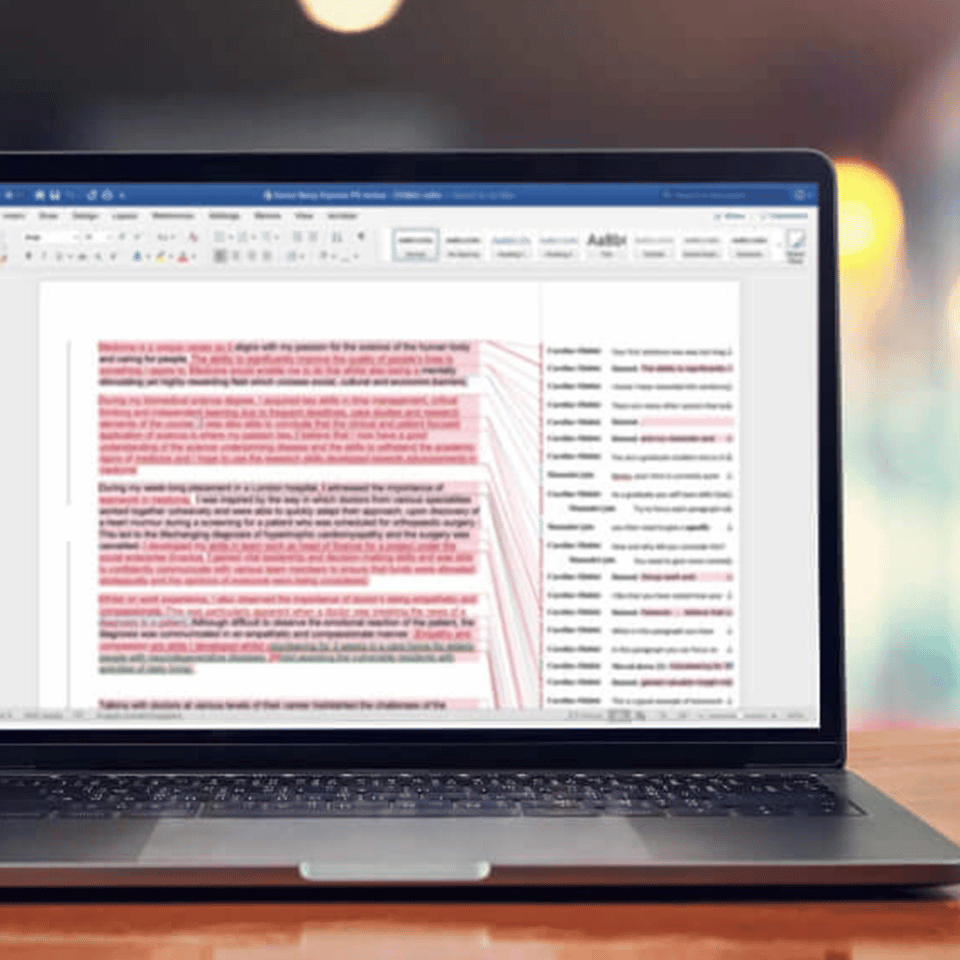
See your draft through admissions eyes.
Know what to keep, rework, cut.
Submit equipped to implement every change.
The thing that decides the score
Forty seconds is what an admissions tutor gives most personal statements before they form an opinion. They read every line, but they don't re-read. They don't go looking for what you meant. Every line either advances your case or it doesn't.
The personal statement is 4,000 characters. Every line earns its space, or it doesn't.
What I send back is what an admissions tutor would think of every line of your draft. Comments where the line is doing its job, comments where it isn't, and concrete options for what to do instead.
The review is built around that moment.
As a child, I was always attracted to medicine.strike
Shadowing my GP showed me what the role is really like.
I admire how doctors work in multidisciplinary teams.
From volunteering at the care home, I learned empathy.Show, don't tell.
★ Reflection over narration. Specific patient detail.
When a personal statement comes in, I read it twice. Knowing what I'm looking for helps you write better even before I get to it.
The personal statement is 4,000 characters. I name the lines that are doing the job, the lines that aren't, and the options for what to do instead. Paragraph by paragraph.
"As a child, I was always attracted to medicine" reads as a feeling, not a decision. I look for what triggered the interest and what confirmed it once you went and looked at the profession close up.
MotivationIf your story starts with a sick relative, you have to push past the event itself to what about it made medicine the answer for you. Graduate applicants also need to tell me why now, at this stage of life.
MotivationIf your statement could have been written by a future nurse, a future physiotherapist, or a future researcher, it isn't doing the work it needs to do. I look for what makes the doctor's role the one you want.
MotivationA good paragraph is the insight you drew from what you saw, not a description of what happened. I show you where to add the reflection: a skill, an insight, or what confirmed your motivation.
EvidenceAuthenticity comes through specificity. Talk about one patient, not patients in general. If you've used "multidisciplinary team," I'm checking that you've placed it where it fits and that you show you understand it.
EvidenceSaying you have leadership, organisation, empathy, resilience, without an example a reviewer can picture doesn't earn the claim. I flag every claim that isn't backed and show how your examples can do the work.
EvidenceSome statements read like a book: long narrative, then a single sentence of reflection. Others go the other way: one line of story, all reflection. Neither works. The reader needs enough detail to follow what happened.
VoiceThe most common structure I see, one paragraph per category, wastes the most space. If you reflected on communication in the GP paragraph and again in volunteering, you used valuable characters twice. I draw the rebuild for you, using your own content.
StructureDifferent schools weight different criteria. I mark your statement against my own marking scheme plus the schemes of up to four schools you're applying to, with a score per category for each.
Cross-cutting · scoringPicture the person at the other end. A doctor or medical student on the admissions panel, October, mid-cycle, working through a stack of personal statements that all start to read the same after the twentieth one.
Yours has roughly forty seconds to make them stop, lean in, and feel interested.
That is one of the key gaps a review closes.
Send your draft to hello@themsag.com. Word document so track changes work. Standard turnaround is under 72 hours. Rush is under 24 hours. Most students fit at the lowest length band. The review covers your statement against my marking scheme plus the marking schemes of up to four schools you choose.
One review per purchase. Most students buy 2 to 3 across drafts because each draft is read fresh. If anything in the review is unclear, you can email me or WhatsApp me and I'll talk it through. If you need ongoing direction across the cycle, the consulting service is the right next step. Link below.
Every review includes the same six things, grouped here in three layers. The detail is the point. The review is designed for you to be equipped to implement, not just see that something needs to change.
One review per purchase. Most students buy 2 to 3 across drafts because each draft is read fresh. Need unlimited rewrite rounds and ongoing direction across the cycle? See consulting →
Sole reviewer
I personally read every personal statement that comes in. There is no team. There are no junior reviewers. The comments, the track changes, the structure analysis, and the summary at the top are mine.
You email your draft and the schools you want it marked against. I confirm receipt and the turnaround window the same day.
I read the whole statement once, the way an admissions tutor would. No notes yet. Just forty seconds of attention, end to end.
Second read, this time marking. Comments on every line, track changes where the language is fighting the content, options for what to do instead.
I build the structure analysis table proposing a rebuild using your own content. Then I mark against my scheme and the schemes of up to four schools you chose.
Back inside 72 hours standard, 24 hours rush. Word document with the comments, track changes, structure table, and a summary at the top with the 2-3 changes that move the score most.
“I'm reading it the way an admissions tutor would, paragraph by paragraph.”
Dr. Dibah · sole reviewer
Reviewing a personal statement is a judgement task, not a checklist. After thousands of reviews, I know how an admissions tutor reads each line. The review you receive reflects that judgement, paragraph by paragraph.
School-leavers, GEM, mature applicants, re-applicants, internationals. Every UK route, year on year.
Thousands across nineteen years. Every one read personally by me, never handed off.
I know the published marking criteria of every UK medical school I send students to. Mark against up to four per review.
I've worked with school-leavers applying to A100, graduates applying to GEM, mature applicants making a career change, re-applicants who didn't get an offer last year, and international applicants writing from Canada, the UAE, Hong Kong, Nigeria, and elsewhere. I've written my own marking scheme and I know the published marking criteria of every UK medical school I send students to.
The review you receive reflects that. Not a generic checklist. A judgement, paragraph by paragraph.
Personal statement questions
Most personal statement reviews come back as a marked-up Word document and stop there. The review I send back includes comments on every line with options and examples, edits in track changes where the language is fighting your content, a structure analysis table proposing a rebuild using your own content, marking against up to four of your school choices, and a short summary at the top of the document with the 2 to 3 changes that move the score most. The detail is the point. The review is designed for you to be equipped to implement.
If you want to, yes. But I recommend the written review as the first thing, not a call. The personal statement is a written piece of your application, and the comments and track changes need to live next to the lines they're about. After a call, students often feel clear in the moment and then struggle to remember which advice applied to which paragraph. A written review doesn't disappear.
Standard turnaround is under 72 hours. Rush is under 24 hours. Rush adds £30. Both are measured from the time you send the statement, not from the time you purchase.
Email it to hello@themsag.com after purchase. Word document is preferred so the track changes work. I'll confirm receipt the same day and start within the turnaround window.
Most students purchase 2 to 3 reviews in total across drafts. The first review surfaces the structural and content issues. The second checks how you've implemented the changes. A third is sometimes worth it close to submission, especially if you've added or rewritten a major section. Each review is purchased separately because each draft is read fresh.
Yes. Use the Rush option for the first review so you have time to implement. Most students who pay attention to the comments and the structure analysis can implement a strong rewrite in a few days. If you have time for a second review on the rewritten draft, even better.
No. I don't write personal statements from scratch and I don't ghostwrite. The voice is yours. The review tells you what's working, what isn't, why, and what your options are for fixing what isn't. You write the rewrite yourself, using your own examples. That's by design: the schools want to read your voice, and the review is most useful when it equips you to write better, not when it substitutes for you writing.
Yes. The same review structure and marking applies for medicine, dentistry, veterinary medicine, physician assistant, and nursing personal statements.
The review handles this explicitly. I flag the lines where the language is getting in the way of your content, and I show in track changes how to tighten them while keeping your voice. International applicants writing from outside the UK are a regular part of my caseload.
Yes. Re-applicants are a specific case I work with often. The review will look at your previous statement against your previous outcomes, identify what likely contributed to no offer, and propose what to change. If you'd like more help than the review alone, the consulting service is the right next step.
And what to do about it. Comments on every line, track changes on the document, structure analysis, marking against up to four schools. Back inside 72 hours standard, 24 hours rush. From £85.
financial support available for under-represented applicants